



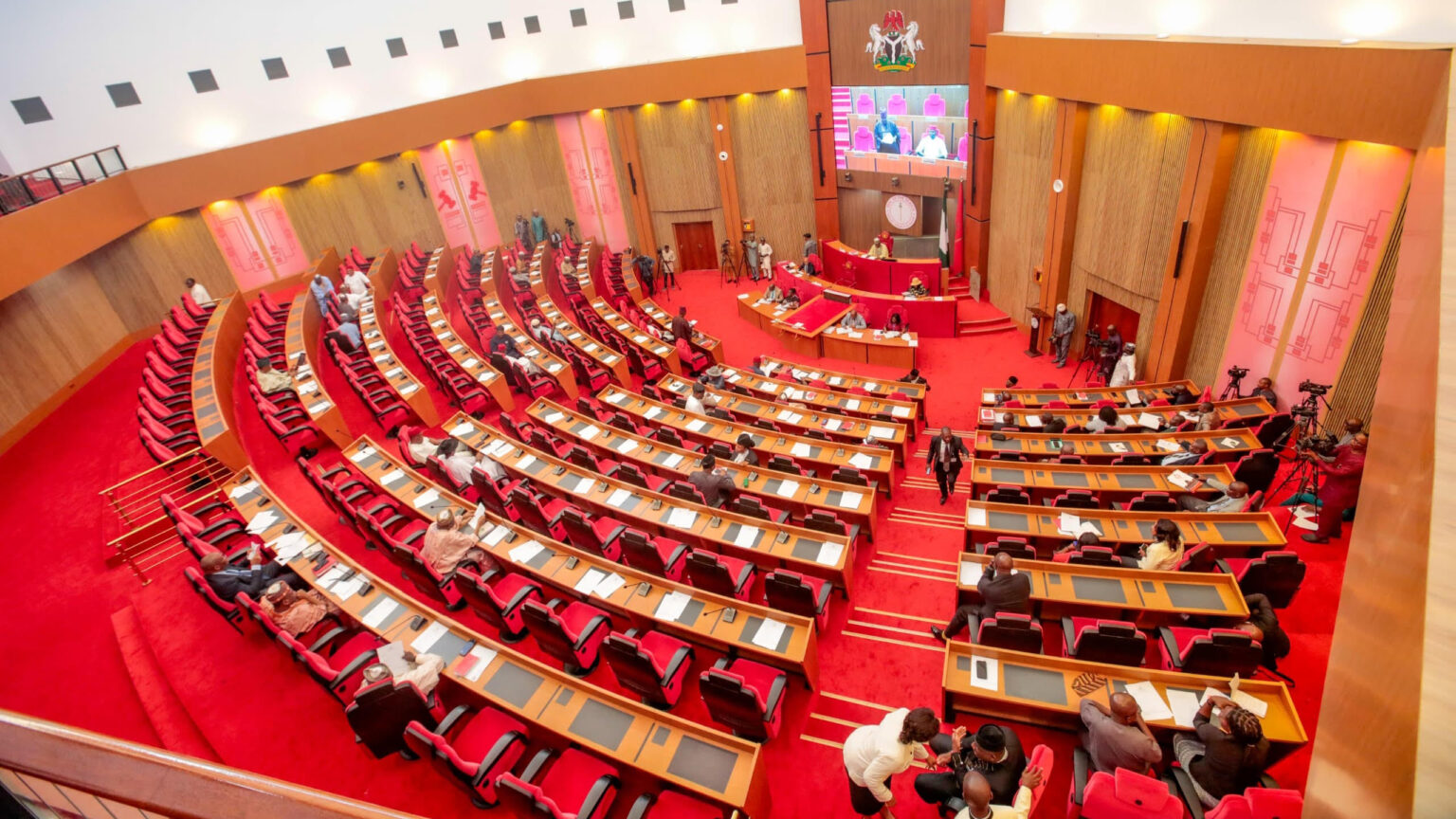
The Senate has released empirical data underpinning its choice to make the electronic transmission of election results discretionary, rather than mandatory, in the ongoing electoral reform process.
According to the upper chamber, this decision was founded on the practical realities facing the nation, not on emotion or sentiment. The Senate reached this position after thorough consultations with key stakeholders in the communications and power sectors, among others.
Senate Leader Opeyemi Bamidele, through the Directorate of Media and Public Affairs, clarified on Sunday that lawmaking carries significant responsibilities worldwide, and the Senate cannot fulfill these duties at the expense of the public.
The Senate rejected Clause 60(3) of the 2026 Electoral Bill, which stipulated that presiding officers “shall electronically transmit the results from each polling unit to the INEC Result Viewing Portal (IReV) in real time.” Instead, the chamber amended the controversial clause to reinforce the electronic transmission of results in line with public demand, but added a caveat: if internet service is unavailable, Form EC8A would serve as the primary method for result collation.
Bamidele noted that, while Clause 60(3) is an innovation that many legislatures worldwide would welcome—given its potential to strengthen trust in democratic institutions like the National Assembly and INEC—the Senate had to consider local realities. He pointed out that Nigeria’s current communications and power infrastructure do not support reliable, real-time electronic transmission of election results, as envisioned by some stakeholders.
Drawing on data from the Nigerian Communications Commission (NCC), Bamidele revealed that by 2025, Nigeria had achieved only about 70% broadband coverage, with internet penetration at just 44.53% of the population. Additionally, the Speedtest Global Index placed Nigeria 85th out of 105 countries in mobile network reliability and 129th out of 150 countries for fixed broadband reliability.
According to the same index, Nigeria’s mobile network speed averaged 44.14 Mbps—far below the United Arab Emirates (691.76 Mbps), Qatar (573.53 Mbps), Kuwait (415.67 Mbps), Bahrain (303.21 Mbps), and Bulgaria (289.41 Mbps). For fixed broadband, Nigeria ranked 129th globally, with an average speed of 33.32 Mbps, compared to Singapore (410.06 Mbps), UAE (382.35 Mbps), France (346.25 Mbps), Chile (348.41 Mbps), and Hong Kong (345.25 Mbps).
Bamidele also cited official statistics showing that at least 85 million Nigerians—about 43% of the population—still lack access to grid electricity. While generation capacity hovers between 12,000 and 13,500 megawatts, the nation’s distribution and transmission systems can only deliver 4,500 megawatts to homes nationwide. However, with the Electricity Act, 2025, improvements are expected in the sector.
Given these infrastructural challenges, Bamidele questioned the feasibility of making real-time electronic transmission of election results mandatory, warning that such a requirement could trigger a national crisis. By global standards, he argued, real-time electronic transmission may not be practicable at this stage of our development.
To prevent compounding the nation’s challenges, the Senate opted to make the provision discretionary, especially since Section 62(2) of the Electoral Act, 2022, already established the National Electronic Register of Election Results.
Bamidele emphasized that these facts, not sentiment or emotion, guided the Senate’s initial decision to retain Section 60(3 & 5) of the Electoral Act, 2022, in the interest of the people and national security. He reiterated that lawmaking requires prioritizing facts and realities over emotion, in line with the Constitution’s expectations of lawmakers.
He concluded that lawmaking is at the heart of democratic governance and must be grounded in evidence and practical realities. If laws fail to reflect the realities of the federation, they risk sowing instability. Consequently, the Senate revised Clause 60(3 & 5), removing the real time requirement to ensure the electoral framework remains responsive to the country’s current circumstances.