



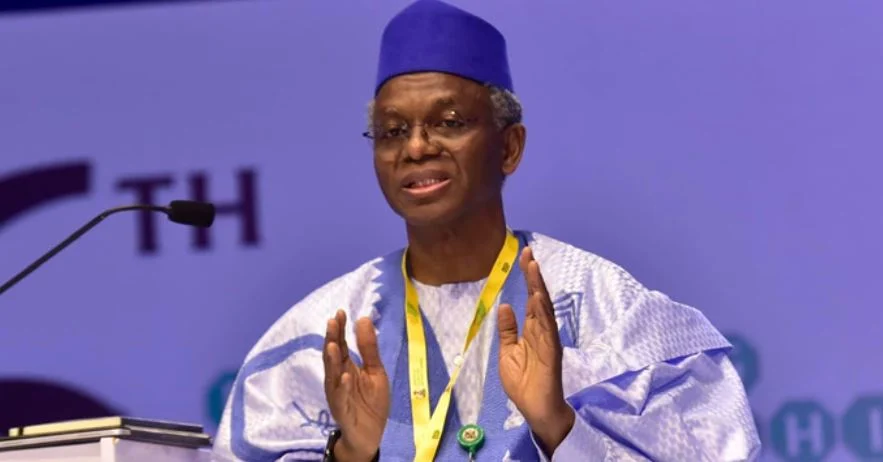
Nasir El-Rufai, former governor of Kaduna State and prominent member of the African Democratic Congress, was detained Monday night at the Economic and Financial Crimes Commission (EFCC) headquarters in Abuja after several hours of interrogation. The detention follows an ongoing probe into alleged misappropriation of N432 billion during his tenure.
Sources within the EFCC confirmed to Gidipoint that El-Rufai arrived at the commission’s Jabi office around 10am in response to a formal invitation and was questioned over allegations stemming from the 2024 Kaduna State House of Assembly report. The report accused his administration of mismanaging loans, disregarding due process in contract awards, and pushing Kaduna State into significant debt. The commission has been investigating him for about a year now, said a senior EFCC official. As of late Monday, El-Rufai was still in custody, with no indication of imminent release.
The EFCC’s spokesperson, Dele Oyewale, verified that El-Rufai honoured the invitation but declined to comment further on the specifics of the interrogation.
Escalating Legal Troubles
The investigation is rooted in findings from the Kaduna State House of Assembly’s ad hoc committee, which alleged that most loans obtained between 2015 and 2023 under El-Rufai were not used for their intended purposes. Speaker Yusuf Dahiru Leman claimed approximately N423 billion was siphoned during El-Rufai’s administration, leaving Kaduna with heavy financial liabilities. The Assembly recommended that El-Rufai and several cabinet members be investigated and prosecuted for abuse of office, contract irregularities, diversion of funds, money laundering, and reckless borrowing. The Assembly’s petition prompted the EFCC and the Independent Corrupt Practices and Other Related Offences Commission (ICPC) to take up the case.
Beyond the headline figures, the legislative report referenced disputed payments and contracts exceeding N155 million, the alleged diversion of N1.37 billion earmarked for a light rail project, and purported laundering of N64.8 million by senior aides. El-Rufai has dismissed the allegations as politically motivated, insisting all loans were properly appropriated for development projects.
New Criminal Charges: Alleged Phone Bugging
While being grilled by the EFCC, El-Rufai also faces criminal charges filed by the Federal Government at the Federal High Court in Abuja. The charges, brought under the Cybercrimes (Prohibition, Prevention, etc) Amendment Act, 2024, and the Nigerian Communications Act, 2003, stem from allegations that El-Rufai and associates unlawfully intercepted the phone communications of National Security Adviser Nuhu Ribadu. The prosecution cited El-Rufai’s public admission during a February 13, 2026 appearance on Arise TV.
El-Rufai is accused of admitting to this illegal activity, failing to report it, and using technical systems to compromise national security. The government argues that his actions caused widespread concern over national security. No arraignment date had been fixed as of press time.
Dadiyata Disappearance Case Reopened
In a parallel development, the Department of State Services (DSS) has reopened its investigation into the 2019 disappearance of Abubakar Idris, known as Dadiyata, a government critic and lecturer. El-Rufai and his sons are reportedly being probed in connection with the case. Security sources revealed that DSS recently seized El-Rufai’s passport to prevent him from leaving the country while investigations continue. Investigators are also examining social media posts from El-Rufai’s sons, Bello and Bashir, for potential leads.
El-Rufai, however, maintains he had no knowledge of or involvement in Dadiyata’s disappearance, insisting the missing lecturer was a critic of another state government.
Public Protests in Abuja and Kaduna
Monday’s developments sparked protests in both Abuja and Kaduna. In Abuja, demonstrators under the Mega National Movement for Good Governance assembled at EFCC headquarters, demanding a thorough probe of El-Rufai. “This is not about persecution; it is about prosecution grounded in law,” said group spokesman Muhammad Abdullahi.
El-Rufai’s supporters also gathered in solidarity, while in Kaduna, civil society groups rallied at the State House of Assembly, demanding updates on the legislative investigation. Speaker Yusuf Leman assured protestors that justice would be pursued, pledging that nobody is above the law.
Victims Demand Accountability
Adding to the pressure, a coalition of terror victims in Kaduna State, represented by former National Human Rights Commission chairman Prof. Chidi Odinkalu, issued a statement demanding accountability for alleged human rights violations during El-Rufai’s tenure. They called for independent investigations and justice for victims of abductions and disappearances, including Dadiyata.
Political and Official Reactions
Opposition figures have reacted sharply to the unfolding events. Ladipo Johnson of the New Nigeria People’s Party (NNPP) criticized the government’s handling, while Labour Party’s Senator Nenadi Usman expressed surprise that charges were filed before El-Rufai was invited to clarify his statements.
Meanwhile, President Bola Tinubu publicly praised National Security Adviser Nuhu Ribadu, calling him “honest, bold, courageous, and committed” during a visit to Adamawa State. This was in the wake of El-Rufai’s recent letter questioning the procurement of a toxic chemical by the Office of the National Security Adviser—an allegation ONSA has denied.
A Defining Legal and Political Battle
The convergence of EFCC detention, fresh criminal charges, DSS investigations, and public protests marks one of the most consequential legal and political confrontations for a former Nigerian governor in recent years. Once a key figure in national affairs, El-Rufai now faces simultaneous investigations into alleged financial impropriety, cybercrime, and a reopened disappearance case.
Whether these cases lead to lawful prosecution or are seen as political persecution will ultimately be determined in court. For now, El-Rufai remains in EFCC custody, his political future uncertain as Nigeria heads toward another election cycle.