




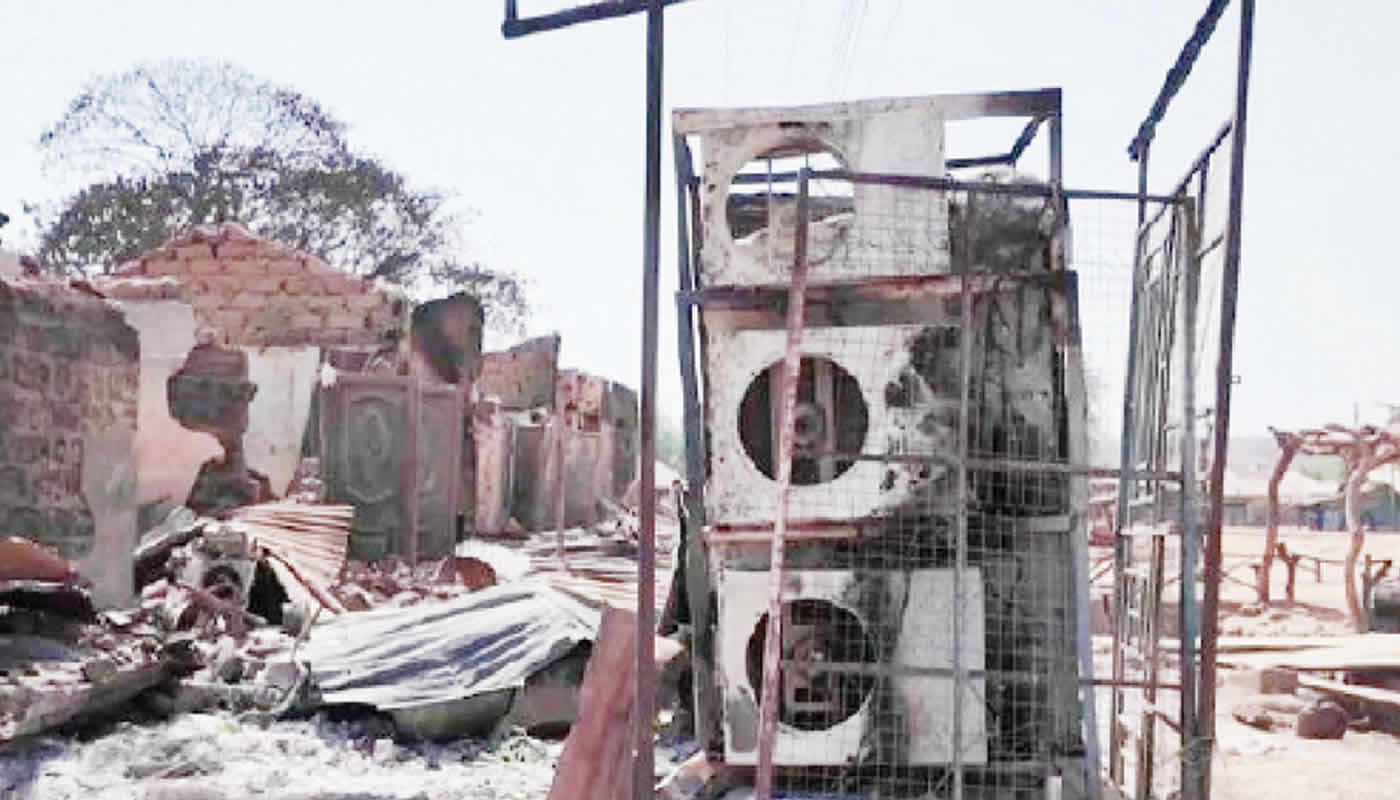
Around 5pm on a dark Tuesday evening, motorcycles began streaming into Woro. By nightfall, gunfire echoed through narrow streets, homes burned, and residents fled into surrounding forests. Today, soldiers patrol the empty settlement, but fear—not security—defines daily life in the agrarian community shattered by one of the deadliest attacks in recent memory.
A Ghost Town Under Guard
Armoured Personnel Carriers now occupy spaces where children once played at dusk. At the entrance to Woro in Kaiama Local Government Area of Kwara State, soldiers in combat gear stop the few vehicles approaching what was once a bustling agrarian settlement.
Police officers man inner checkpoints, rifles slung across their shoulders, eyes scanning tree lines that stretch into thick forests linking Kaiama, Baruten and the Benin Republic. Despite the heavy security presence, Woro remains deserted.
No smoke rises from cooking fires. No traders display grains and vegetables along the federal road cutting through the settlement. Mud houses that survived the flames stand with doors ajar, abandoned in haste.
Many others have been reduced to blackened skeletons, their zinc roofs twisted by heat. Days after the February 3, 2026 attack that claimed more than 200 lives, fear has outweighed the assurances provided by security patrols.
“The people are afraid to return to Woro after experiencing such a tragic incident,” Comrade ZulQharnain Shero Musa, Special Assistant to the Chairman of Kaiama Local Government Area, told The PUNCH. “Many of them feel the place is still not safe despite the military presence.”
Survivors are scattered across neighbouring communities—in Kaiama town, Baruten and parts of Niger State. At the Wawa Internally Displaced Persons camp in Borgu LGA of Niger State, families shelter under makeshift structures.
Relief materials have begun arriving, including bags of rice and maize, mattresses, clothing and medical supplies. Officials have been distributing food items to women and children, many still visibly shaken.
But relief supplies cannot silence the trauma of that evening.
Weeks of Warning Signs
“It was a dark Tuesday night for us in Kaiama,” Musa said. “What happened was painful and devastating. Around 5pm, the assailants came.”
The attack followed weeks of tension after unknown men reportedly visited Woro under the guise of religious outreach.
“They came to preach a strange doctrine that does not align with Islam or Christianity,” Musa explained. “They tried to force it on the people, but the community rejected it. We told them they could practise their religion, but not impose it.”
A letter delivered in January to the village head had raised concerns.
“The Emir read it and forwarded it to the DSS and the palace of the Emir of Kaiama. We do not know how the attackers found out that the letter had been shared,” Musa added.
By Tuesday evening, survivors said the men returned in overwhelming numbers.
The Attack Unfolds
“They came two on each motorcycle—hundreds of them,” Musa recalled. “They were armed with sophisticated weapons. There was no security presence nearby.”
Aliyu Abdul Hamid Jogodo, 22, popularly known as Omo Salka, said the attackers moved through the town without resistance.
“The attackers stormed Woro and went straight to the Emir’s palace,” he said. “They began shooting indiscriminately, killing people and burning shops.
“They killed many of my friends. One of them was Malam Buhari, whose death I will never forget. They also kidnapped my friend’s mother and killed my boss’s brother, Dr Muhammad Yusuf, the officer in charge of the Woro Primary Health Care Centre. The pain is unbearable.”
Abdulrasheed Taofiq, 30, gave a similar account.
“They came into the town on many motorcycles and headed directly to the village head’s house,” he said. “After that, they began gathering people and setting houses and shops on fire. Gunshots were everywhere. There was no way out.”
What followed, according to multiple accounts, was a coordinated assault.
“They cordoned off the village and moved from house to house,” Musa said. “They brought people out, tied their hands behind their backs and executed them.”
The Emir’s Palace Attacked
The Emir’s palace became a primary target.
“They went to the Emir’s house, brought out his children and one of his wives. They executed the children and kidnapped the second wife. By about 6pm, the house was set ablaze,” Musa said.
A 35-year-old resident identified simply as Tunde offered further details.
“The Emir has two wives,” Tunde said. “The first wife was not at home when the attackers stormed the palace. The second wife was kidnapped. They killed all his children and burnt his house.
“The Emir was not at the palace during the attack. He was outside Woro when the assailants arrived.”
Sources confirmed that the monarch survived and is currently in hiding in Kaiama town after his palace was razed. Efforts to speak with him were unsuccessful.
Trapped on the Highway
For residents attempting to flee, the federal road became another danger zone.
“Motorists on the busy road were stopped. People inside vehicles were attacked and killed,” Tunde said.
Our correspondent observed a burnt commercial truck carrying sacks of maize and guinea corn along the road.
Explaining the incident, Tunde said the vehicle struck a landmine while attempting to enter Woro.
“The bomb was buried on the road and was not noticeable. The explosion was massive and delayed the Army’s rescue efforts,” he said. “The soldiers had to retreat to a nearby village. The vehicle was burnt to ashes.”
Hours of Terror
As the attack unfolded, survivors reported seeing an aircraft overhead.
“A white helicopter flew over the village. It circled and left without intervening. After it left, the killings continued from about 6pm to 8pm,” Musa said.
He added that when another aircraft, believed to be military, later returned, the attackers retreated into the forest, only to re-emerge under cover of darkness.
“They came out again at night,” he said. “The killings continued until about 2am.”
A Rising Death Toll
By dawn, the scale of the massacre began to emerge. As of Friday, more than 200 bodies had been buried in mass graves at different locations.
“First it was 30, then 68, then 75,” Musa said. “Later it rose to 162. Now the number recorded is over 200. Some bodies were recovered days later.”
Survivors believe the figure may be higher.
“From what we are seeing and hearing, the number could be more than 300,” Aliyu said.
Abdulrasheed gave an even higher estimate. “Between two days ago and now, we counted 321 bodies in the community,” he claimed.
Musa said more than 100 people were abducted during the attack.
“Over 100 people were kidnapped, and there have been no traces of them,” he said. “During search operations, more bodies have been found in the bush.”
Disguised as Soldiers
Another survivor, who requested anonymity for security reasons, said the attackers disguised themselves.
“They dressed like soldiers and wore full armour. There was even a woman among them carrying ammunition,” she said. “We did not suspect anything at first.”
She recalled seeing them pass her shop along the Kaiama-Woro road.
“Minutes later, we heard gunshots. That was when we realised they were not soldiers. Everyone started running.”
Some of her relatives were abducted.
“My seven-year-old stepsister, who has a chronic illness, was taken during a family event in Woro. Another sister was also abducted. I do not know how the little one will survive in the forest,” she said.
She also recounted the ordeal of a trader popularly known as “Iya Bag.”
“They tried to break into her house but failed. They set it on fire, thinking everyone inside was dead. The family escaped through a back window, but she lost everything,” she said.
The violence reportedly spread to neighbouring Nuku village. Even days later, residents said they heard distant gunshots in the early hours of Thursday, fuelling fears that more victims were killed in the surrounding forest.
Stories of Survival
Aliyu described how he survived.
“When the shooting started, I ran into the bush. I stayed there until morning before returning,” he said.
Abdulrasheed also recounted his escape. “I ran into a nearby house and hid,” he said.
Both men said nearly all residents had fled.
“Almost everyone has left,” Aliyu said. “People packed what they could carry and fled.”
The Aftermath
Hospitals in Kaiama and New-Bussa have continued treating injured survivors. A source familiar with the situation said many victims were in serious condition but responding to treatment.
The Inspector-General of Police, Kayode Egbetokun, has sent a delegation to the area as part of ongoing security and assessment operations. Security has since been reinforced across the Kaiama axis, with soldiers patrolling adjoining roads and border communities.
Yet the deserted homes reflect a deeper crisis—trust in safety has not returned.
“There is illegal mining in the forest,” a community member who requested anonymity said. “The group known locally as the Mahmuda terrorists have built houses there. Farmers can no longer go to their fields.”
Woro’s farmlands, once the backbone of its economy, now lie untended. Dry-season crops remain unharvested, and livestock have either strayed or been stolen.
For many families, returning would mean confronting both trauma and the destruction of their livelihoods.
Waiting for Justice
At the IDP camps in Wawa and other host communities, displaced residents gather in prayer. Children cling to their mothers, while men speak quietly about relatives still missing.
We have never seen anything like this, Musa said
Aliyu appealed for urgent intervention. The government should assist our community with security and relief materials. We are pleading for help, he said.
Abdulrasheed added, Security agencies should remain in the community and support those whose homes and property were destroyed.
In Woro, fresh graves dot the outskirts of the village. The scent of burnt timber lingers in the dry air as security operatives continue their patrols.
Until the abducted return and residents regain confidence to rebuild, Woro remains not only under guard, but in mourning.




