



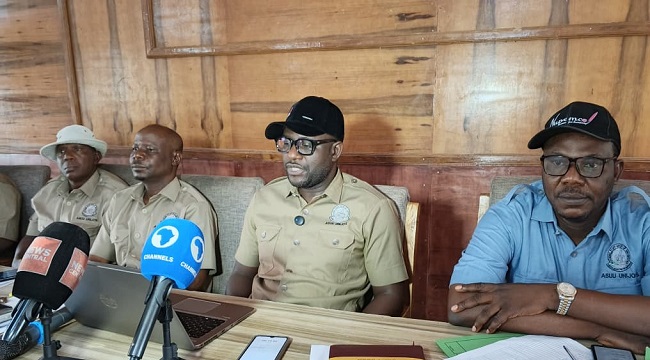
The Academic Staff Union of Universities (ASUU), University of Jos branch, has issued a warning of an impending industrial crisis in Nigeria’s public universities, citing the Federal Government’s slow and inconsistent implementation of the 2025 FGN/ASUU agreement.
Read more: ASUU Warns of New Strike Over Delay in Implementing 2025 AgreementAt a press conference held Monday at the union’s secretariat in the University of Jos, branch leaders expressed mounting frustration among academics. They cautioned that the fragile peace within the university system could soon unravel unless urgent corrective action is taken.
According to the union, its National Executive Council (NEC)—which convened at Modibbo Adama University on May 9 and 10, 2026—reviewed the progress of the December 23, 2025, agreement with the government and found compliance to be inadequate.
ASUU warned that the government’s failure to fully implement the agreement could provoke a new wave of industrial action across public universities. The union specifically criticized the Federal Government for not inaugurating the Implementation Monitoring Committee (IMC), a body intended to oversee the agreement’s rollout and prevent administrative obstacles.
In the absence of the IMC, ASUU said major salary-related components—such as the Consolidated Academic Tool Allowance (CATA), Earned Academic Allowance (EAA), Professorial Allowance, and responsibility allowances—have seen what it described as “selective and distorted implementation.”
Nonetheless, the union acknowledged Sa’adu Zungur University and Ekiti State University for partially implementing aspects of the agreement and urged other institutions and authorities to expedite compliance to prevent a breakdown of industrial harmony nationwide.
ASUU also criticised the Federal Government’s unilateral establishment of the National Research and Innovation Development Fund (NRIDF), announced by Education Minister Tunji Alausa, without consulting the union. The union questioned the fund’s proposed dollar-denominated structure, warning it could expose Nigeria’s education sector to external influence and “neo-liberal control mechanisms.”
ASUU insisted that research funding provisions contained in the 2025 agreement must be fully honoured.
The union further highlighted unresolved welfare issues affecting lecturers, including arrears of the 25/35 per cent wage award, outstanding promotion arrears, withheld salaries from the 2022 strike, salary shortfalls linked to the Integrated Payroll and Personnel Information System (IPPIS), and unremitted third-party deductions.
The union condemned the withholding of salaries under the “no work, no pay” policy, arguing that academic activities continued during the strike through research and community engagement.
Concerns were also raised regarding the welfare of retired academics—particularly in state universities—pointing to prolonged pension arrears and delays in harmonisation by the National Pension Commission (PenCom). ASUU appealed to President Bola Tinubu to intervene and address the challenges faced by affected retirees.
In addition, the union criticised recent Federal Government policy reversals, such as the abandonment of the mother-tongue instruction policy in early childhood education and the proposed Transnational Education arrangement with Coventry University, which it described as a “neo-colonial academic model.”
ASUU opposed efforts to scrap certain university courses, insisting that every academic discipline plays a role in national development. The union also criticised the proposed introduction of new academic titles—such as Professor of Practice and Diaspora Professor—arguing that such measures undermine university autonomy.
Beyond educational matters, ASUU voiced concern over worsening economic hardship, insecurity, and rising political tension ahead of the 2027 general elections. The union warned that growing poverty, unemployment, and insecurity are aggravating living conditions and increasing public frustration.
ASUU cautioned that continued delays in agreement implementation and settlement of outstanding entitlements could trigger renewed industrial action. The union concluded by urging the government and relevant stakeholders to ensure the full implementation of the 2025 agreement to safeguard stability in Nigeria’s public university system.