



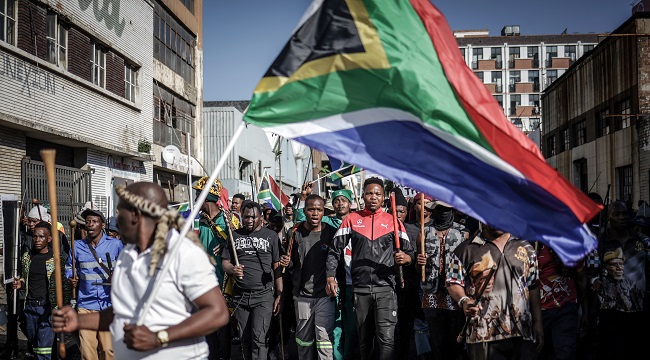
The Federal Government has issued a strong call to South African authorities to take concrete steps in response to ongoing xenophobic attacks against Nigerians living in South Africa.
During a meeting on Monday with South Africa’s Minister of International Relations and Cooperation, Ronald Lamola—special envoy to President Cyril Ramaphosa—Nigeria’s Minister of State for Foreign Affairs, Ambassador Sola Enikanolaiye, expressed mounting concerns over repeated acts of xenophobic violence targeting Nigerians.
“We have observed a disturbing pattern of attacks dating back to 1995 and recurring in subsequent years, including 1998, 2006, 2015, 2016, 2019, 2021, 2024, and 2026,” Ambassador Enikanolaiye said. “In fact, since 2022 alone, 98 Nigerians have lost their lives to mob violence and hate-driven actions we refer to as Afrophobia, as the primary victims have been Africans—Nigerians in particular.”
He acknowledged South Africa’s expressions of goodwill but emphasized the urgent need for tangible measures to end these attacks. “While we value warm sentiments and our shared commitment to excellent relations, it is imperative to take urgent, concrete action to address these ongoing Afrophobic attacks. Enough is enough—this is why we are addressing this issue so firmly.”
The minister stressed that migration is a historical reality, and those who break the law should be dealt with according to established legal procedures. “If there are criminals, the solution is not extrajudicial killing. As nations governed by the rule of law, those accused of crimes like drug trafficking should be arrested, prosecuted, and, if found guilty, jailed. The Nigerian government does not support criminal activity, but we insist on fair treatment in line with constitutional and international human rights standards.”
Ambassador Enikanolaiye added, “Unfortunately, many victims have been law-abiding Nigerians with proper documentation. We have witnessed incidents where police stood by as mobs attacked, raising serious concerns about state responsibility and possible complicity when authorities fail to act.”
He explained that President Bola Tinubu had directed the meeting to address these attacks candidly and urged South Africa to take immediate and decisive action to end the violence, warning that continued attacks threaten the longstanding strategic partnership between the two nations.
Enikanolaiye highlighted Nigeria’s historic support for South Africa’s anti-apartheid struggle and the close cooperation between both countries in transforming the Organisation of African Unity into the African Union and advancing the New Partnership for Africa’s Development (NEPAD).
In recent months, South Africa has seen a surge in protests—some violent—targeting African immigrants, who are often blamed for crime, unemployment, and pressure on public services.
Since the latest wave of attacks, the Nigerian government has evacuated approximately 1,500 of its citizens from South Africa. “Repatriation has been a traumatic experience for the victims and for us as a government,” Enikanolaiye said. “I remember receiving the first batch of returnees—children, women, and the elderly—who arrived with almost nothing after losing their homes and belongings. This is not how African nations should relate to each other.”
South African police report at least four foreign nationals have died in recent attacks, though some African governments claim higher casualties. Over 160,000 people have fled South Africa, including about 1,500 Nigerians, according to AFP tallies based on government figures.
Nigeria and Ghana have been especially vocal in criticizing South Africa’s response to the violence. In some cases, anti-immigrant groups have forcibly removed people from their homes and handed them over to police.
Responding to the concerns, South Africa’s delegation argued that the country is confronting criminal activity involving some immigrants, such as drug trafficking and wire fraud. Minister Lamola affirmed, “President Ramaphosa and his government are opposed to all forms of intolerance. However, South Africa reserves the right to address irregular migration, undocumented immigrants, and criminal acts decisively.”
South Africa, one of Africa’s most industrialized economies, has long attracted both documented and undocumented immigrants. However, with high unemployment, overstretched social services, and widespread crime, immigrants are often scapegoated for broader societal problems, analysts note.