



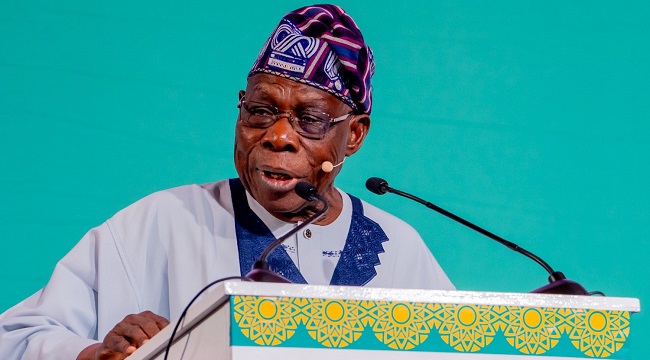
Former President Olusegun Obasanjo has urged increased private sector involvement in Nigeria’s energy sector, emphasizing that government efforts alone cannot resolve the nation’s ongoing electricity crisis.
Speaking at the Youth Governance Dialogue, themed “African Youth and Renaissance,” held at the Youth Development Centre of the Olusegun Obasanjo Presidential Library in Abeokuta, Ogun State, Obasanjo drew parallels to the transformation of the telecommunications industry, noting that significant progress was made only after the sector was opened to private operators.
He argued that a similar shift is needed for sustainable improvement in electricity supply.
“Government has tried, just like we tried with telecommunications. Until we put it in the hands of the private sector, we didn’t solve it. And I believe that until we put energy in the hands of the private sector, we won’t solve it,” Obasanjo stated.
Describing energy as fundamental to economic growth and national development, the former president lamented Nigeria’s slow progress in tackling its power challenges. Nonetheless, he expressed confidence in the potential of young Nigerians to drive change, urging them to turn innovative business and technological ideas into practical solutions.
Obasanjo also encouraged young people aspiring to shape governance and public policy to develop the knowledge and skills necessary for meaningful engagement with government institutions.
At the event, resource person Oluwaseun Obasanjo called on Nigerian youths to embrace innovation, technology, and entrepreneurship as tools for solving the country’s development issues. He highlighted Nigeria’s large population and consumer market as significant opportunities for young entrepreneurs, despite obstacles like inadequate power and infrastructure. Oluwaseun challenged youths to create homegrown solutions capable of competing with foreign businesses entering the Nigerian market.
He advised young people to identify challenges in their communities and workplaces and transform them into innovative solutions with economic value. “Every problem we have is an opportunity to innovate, not just in Nigeria, but across Africa, as we share similar challenges,” he said.
Oluwaseun also warned that young people who fail to adapt to modern technology and artificial intelligence could be left behind in today’s digital economy. He stressed the importance of lifelong learning, encouraging youths to utilize free online platforms, such as YouTube, to gain skills in fields like marketing, software development, and management.
Dr. Ayodele Aderinwale, a mentor at the programme, urged Nigerian youths to deepen their engagement in governance through evidence-based advocacy, institutional development, and consistent participation in political and civic structures. He emphasized the need for credible proposals backed by facts and data, rather than relying solely on complaints or demonstrations.
Aderinwale advised youths seeking to influence state budgets to thoroughly study them—understanding allocations for capital spending, salaries, and discrepancies between approved and actual expenditures. He also recommended that those interested in education policy familiarize themselves with conditions in public schools, such as teacher salaries, infrastructure, and basic amenities.
“Have facts, have data,” he said. “When a young person presents a well-researched, costed alternative, officials are more likely to engage in negotiation.”
He identified political parties, professional associations, trade unions, cooperatives, religious organizations, chambers of commerce, alumni networks, and businesses as effective platforms for sustained youth participation in governance. Aderinwale encouraged youths to join established institutions and actively participate beyond election campaigns and rallies, stressing the importance of organizational management skills for building sustainable institutions.