




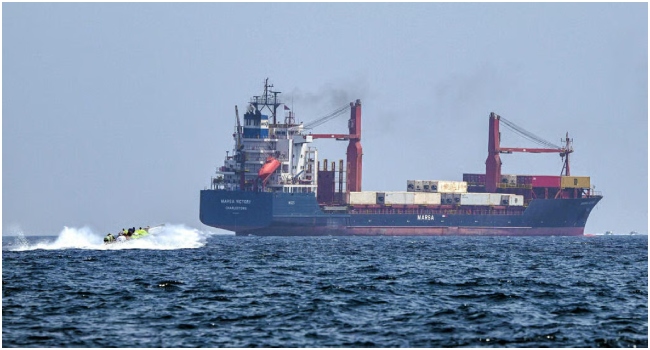
The US military announced it will begin blockading all Iranian ports on Monday, following the collapse of peace talks between Iran and the US in Pakistan. President Donald Trump blamed Iran’s refusal to abandon its nuclear ambitions for the failure of negotiations.
Trump declared on social media that the US would block the strategic Strait of Hormuz—a vital global oil route—insisting Tehran must fully reopen the waterway. This announcement came after Vice President JD Vance ended talks with Iranian representatives in Islamabad on Sunday.
The breakdown of negotiations dashed hopes for a deal to bring a lasting end to the war, which has killed thousands and disrupted the global economy since late February.
As delegates departed Pakistan, the host nation pledged to continue facilitating dialogue and urged both sides to maintain the fragile two-week ceasefire reached last week. Experts warn, however, that a maritime blockade could jeopardize the truce.
US Central Command said in a statement that the blockade would apply equally to vessels from all nations entering or leaving Iranian ports along the Arabian Gulf and Gulf of Oman, beginning at 1400 GMT on Monday. US forces would not stop ships transiting the Strait of Hormuz to or from non-Iranian ports.
Trump confirmed the military’s plans on Truth Social, offering a narrower scope than previous statements suggesting all traffic through the strait would be halted.
Prior to the US announcement, Iran’s Revolutionary Guards claimed full control over Hormuz and threatened to trap any challenger. In his social media post, Trump asserted his aim was to clear the strait of mines and allow free passage but insisted Iran must not benefit from controlling the route.
Effective immediately, the United States Navy will begin blockading any and all ships trying to enter or leave the Strait of Hormuz, Trump said. Any Iranian who fires at us, or at peaceful vessels, will be blown to hell!
Oil prices jumped about eight percent on Monday, with both WTI and Brent crude surpassing $100 a barrel, after falling last week during the temporary ceasefire.
Iran’s parliamentary speaker Mohammad Bagher Ghalibaf, who led Tehran’s delegation, vowed Iran would not bow to any threats from Washington. Iranian navy chief Shahram Irani dismissed Trump’s threat as ridiculous.
After the highest-level US-Iran talks since the 1979 Islamic Revolution failed, Iranian Deputy Foreign Minister Abbas Araghchi blamed US “maximalism, shifting goalposts, and (a) blockade” for preventing an agreement he claimed was close.
Trump told reporters he was indifferent to the prospect of further talks, saying, If they don’t come back, I’m fine.
Final and Best Offer
Tehran has already restricted traffic through the Strait of Hormuz—a key route for global oil and gas—though it allows some vessels serving friendly nations such as China to pass.
Nicole Grajewski, assistant professor at Sciences Po, noted that a US blockade is not a minor coercive signal but could mark a resumption of war.
On Saturday, the US said two Navy warships entered the strait to begin clearing mines, a claim Iran denied. Iran’s Fars news agency reported two Pakistan-flagged oil tankers had turned back from the strait on Sunday.
The Strait remains just one flashpoint in the ongoing conflict, which began when Israel and the US struck Iran, prompting Iranian retaliation against Gulf and Israeli cities.
The US delegation in Islamabad—led by Vance, special envoy Steve Witkoff, and Trump’s son-in-law Jared Kushner—expressed frustration with Iran’s insistence on maintaining its nuclear program. Iran will never have a nuclear weapon, Trump reiterated online.
Vance described the US proposal as its final and best offer, adding, We’ll see if the Iranians accept it.
Violence in Lebanon
Meanwhile, concerns persist over the ceasefire’s stability amid continued Israeli strikes against Iran-backed Hezbollah in Lebanon—where Iran and Pakistan insist the truce should also apply.
Lebanese Prime Minister Nawaf Salam pledged to stop the war and press for an Israeli withdrawal, though Israeli Prime Minister Benjamin Netanyahu told troops in southern Lebanon that fighting would continue.
Lebanese and Israeli officials are scheduled to meet in Washington on Tuesday.
Hezbollah claimed to have fired rockets into northern Israel overnight, continuing attacks that began in early March following the death of Iran’s supreme leader in the opening Israeli-US strikes. Israeli raids on Beirut and other parts of Lebanon last week, after the ceasefire announcement, killed hundreds, according to Lebanese health authorities.
AFP




