



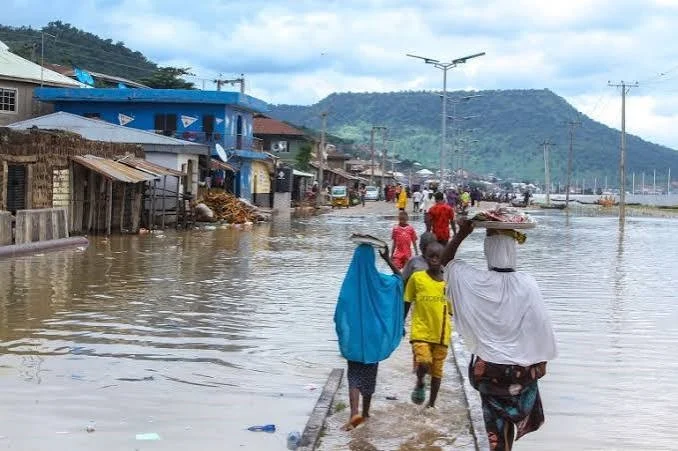
Torrential rainfall on Sunday brought Lagos to a standstill, flooding major roads, forcing businesses to close, and temporarily halting operations at the international terminal of Murtala Muhammed International Airport.
The deluge has heightened anxiety among residents, especially as meteorological agencies warn of increased flood risks in the months ahead.
The June 28 downpour submerged areas including Oshodi, Mushin, Surulere, Fashoro Street, Akowonjo Road in Egbeda, Gbagada Expressway, and Idi-Oro. This severe weather came as federal agencies flagged July to September as Lagos’ peak flood period.
At the airport, floodwaters inundated the temporary international terminal’s power house, prompting the Federal Airports Authority of Nigeria to cut power as a precaution and relocate airlines such as Air France-KLM, Ethiopian Airlines, and Fly Gabon to Terminal Two.
In neighborhoods like Gbagada, Ipaja, and Surulere, floodwaters rose to knee level, disrupting movement and daily routines. Oshodi’s bus terminal was overwhelmed, with passengers scrambling for safety as vehicles became partially submerged. Videos shared across the city captured scenes of homes inundated to window height and ground floors nearly underwater.
By Monday, floodwaters had mostly receded and commercial activity resumed. However, residents and traders said the flooding again exposed Lagos’ vulnerability despite repeated government assurances and annual flood preparations.
The Nigeria Hydrological Services Agency, Nigerian Meteorological Agency, and National Emergency Management Agency have all identified July to September as Lagos’ period of highest flood risk, suggesting Sunday’s rainfall is an early warning for the rainy season’s peak. NiMet’s 2026 forecast, released in February, predicts above-normal rainfall for Lagos, with up to 2,010mm expected in Badagry Division and an average of 1,965mm state-wide. These projections are attributed to prevailing climate conditions, including a weak La Niña and a neutral El Niño Southern Oscillation phase, pointing to an early start and late end to the rainy season.
NIHSA’s 2026 Annual Flood Outlook, presented in April, places Lagos among 33 states at high risk, citing flash flooding, riverine flooding, and coastal surges as major threats. The agency warns that rapid urbanization, coastal geography, and strained drainage infrastructure are compounding the city’s exposure to flooding.
NEMA’s Lagos office has identified Badagry, Epe, Alimosho, Ikeja, and Surulere as flash flood hotspots, while warning that Ikorodu and Isheri could be affected by potential water releases from the Oyan Dam between July and October.
In response, the Lagos State Government says it is implementing both immediate and long-term measures. Mahmood Adegbite, Permanent Secretary of the Office of Drainage Services and Water Resources, told The PUNCH that flood prevention remains a top priority, with expanded interventions and the introduction of flood insurance for affected residents.
Adegbite highlighted the ongoing System 1 drainage channel project, a key flood-control initiative that is still in its early phase. He explained that persistent rainfall and saturated ground conditions had overwhelmed the city’s drainage capacity, while inspections continue to reveal illegal buildings on wetlands and water channels, exacerbating the problem. The government has started removing such structures and is considering new planning policies, such as requiring 40 percent green space in residential compounds to reduce runoff into public drains.
Tokunbo Wahab, Lagos State Commissioner for Environment and Water Resources, urged residents to stay calm, describing Sunday’s event as flash flooding that would subside. He attributed Lagos’ challenges to its coastal location and high lagoon levels, which hinder drainage during intense storms. Wahab also called on residents to avoid dumping waste in drainage channels and prevent illegal development on drainage setbacks.
Two weeks before Sunday’s rainfall, Wahab’s ministry had already issued a flood warning for key areas including Apapa, Badagry, Epe, Eti-Osa, Ikeja, Ikorodu, Ikoyi, Lagos Island, Lekki, Ojo, Orile-Agege, Surulere, Agege, Alimosho, and Kosofe. For communities along the Ogun River, such as Ajegunle and Itowolo in Ikorodu and Isheri, the coming months may be especially challenging.