



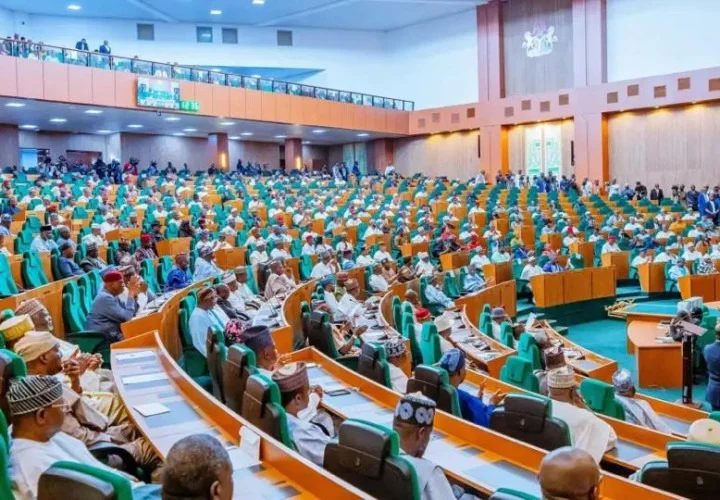
The House of Representatives Ad-hoc Committee investigating the alleged establishment and activities of the Presidential Foreign Investment Promotion Council (PFIPC) has announced plans to interrogate the council’s purported Director-General, Prince Adeniyi Adeyemi, while he remains in police custody.
The committee emphasized that questioning Adeyemi at an undisclosed location is necessary to avoid jeopardizing ongoing investigations by security and anti-corruption agencies.
The committee was set up to examine allegations of impersonation, forgery, financial misconduct, and the unlawful use of government facilities and insignia linked to the PFIPC. Its mandate includes uncovering how the council allegedly operated, identifying those involved, tracing its funding sources, and determining whether public officials aided its activities. The committee is expected to conclude its hearings this week before presenting its report to the House for further legislative action.
Additionally, the committee has summoned the Corps Marshal of the Federal Road Safety Corps, Shehu Mohammed, to appear on Thursday regarding the use of official government number plates on vehicles associated with the purported council.
Revelations from the Victim
These developments follow testimony from Gbenga Collins, Managing Director of Divine Dopacy Nigeria Limited, who told lawmakers he paid N400 million to Adeyemi after being promised a contract to renovate and furnish what was presented as the council’s official residence.
Collins recounted that he believed the PFIPC was a legitimate government agency because Adeyemi operated from an office in the Federal Secretariat, Abuja, and was accompanied by security personnel and official vehicles bearing government number plates. Collins recalled meeting Adeyemi—whom he knew as a fellow Ogbomoso indigene—at a hometown event in December 2024, after which Adeyemi invited him to Abuja to discuss a business opportunity.
Upon arrival, Collins was picked up by an official car and taken to Adeyemi’s office, where he saw numerous dignitaries and security officers. Adeyemi introduced himself as the Director-General of both the Presidential Economic Advisory Council and the PFIPC, and Collins said the official setting left him with no reason to question Adeyemi’s claims.
Adeyemi later told Collins he had been assigned an official residence and wanted Divine Dopacy to handle its renovation. Adeyemi personally took Collins to inspect the property, accompanied by several vehicles and security staff. In April 2025, Adeyemi allegedly handed Collins a contract award letter, the project’s scope of work, and a formal agreement with Divine Dopacy.
Collins testified that Adeyemi required him to pay N400 million as proof of the company’s financial capacity and to facilitate contract mobilisation. He raised the funds from business associates, paying N380 million in four instalments to a Guaranty Trust Bank account in the name of World Entrepreneurs Limited, and the remaining N20 million to an Access Bank account belonging to Sunshine Confectionery and Catering Services.
Despite repeated assurances from Adeyemi that project mobilisation would begin in August 2025, nothing materialized. Collins was later told there were security delays, followed by further unfulfilled promises of payment in November. After being unable to reach Adeyemi, Collins sought legal counsel. His lawyer informed him he had likely been defrauded and subsequently petitioned the Economic and Financial Crimes Commission (EFCC) in November 2025. Investigators later told Collins that Adeyemi consistently failed to honour EFCC invitations, citing ill health through his lawyer.
Collins said the alleged scam devastated his business, forcing him to sell personal assets to repay associates who had entrusted him with funds. He insisted he acted in good faith, believing Adeyemi was a legitimate official due to the convincing government setting and their shared background.
During the hearing, committee chairman Yusuf Gagdi asked Collins whether the N400 million payment constituted a bribe. Collins denied this, stating the payment was presented as a contract facilitation requirement. Lawmakers also questioned whether Collins had complied with the Public Procurement Act, to which he admitted he had not.
Collins appealed to the committee for assistance, stating, “I just want to beg the Chairman and the honourable members to help me talk to all the agencies involved because I have been frustrated, especially by those people who gave me the money. I have started selling my property. My business is not going well again.”
Committee’s Approach to Interrogating Adeyemi
Addressing Adeyemi’s absence from the public hearing, Chairman Gagdi clarified that the committee is bound by a court order requiring Adeyemi to remain in police custody. He stressed that the National Assembly respects the separation of powers and cannot override a court order to produce Adeyemi for a public hearing.
However, Gagdi disclosed that the committee would question Adeyemi at an undisclosed date and location, in the presence of his lawyer and police, to avoid interfering with ongoing investigations by the EFCC, the Independent Corrupt Practices and Other Related Offences Commission (ICPC), and the police.
He explained, “We will not announce to the general public when we will interact with Prince Adeniyi. To do so would undermine ongoing investigations. The most important thing is to have an interaction with him to get necessary clarifications.”
Gagdi concluded that the committee’s priority is to obtain the facts from Adeyemi, regardless of whether the session occurs at a public hearing or another location.