



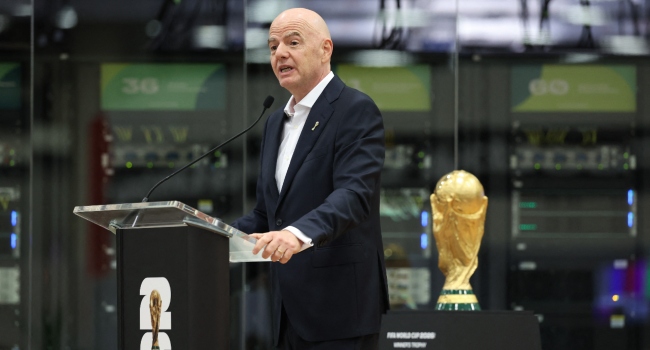
FIFA president Gianni Infantino faced renewed criticism on Monday after a joint letter from three major football confederations UEFA, CONCACAF, and the AFC—declared that football belongs to no individual.
Infantino has been under fire since unveiling, and then swiftly withdrawing, a controversial plan to introduce private investment into FIFA competitions, including the World Cup.
FIFA responded on Saturday by denouncing what it called “a concerted and ongoing effort by some to undermine both the organization and its president. But the letter from the European (UEFA), North and Central American (CONCACAF), and Asian (AFC) football governing bodies underscored that criticism remains fierce.
Leadership in football is not a possession. It is not about holding or demanding power, the confederations wrote. When trust is broken through deception, when an individual places himself above the collective that entrusted him with authority, that duty has been abandoned.
The three confederations had already been vocal in their opposition to Infantino’s investment plan and continued to press their case even after it was dropped. CONCACAF president Victor Montagliani is seen as a possible challenger to Infantino, who plans to seek a fourth and final term in the FIFA presidential election scheduled for next March in Rabat. Candidates must declare by November 18.
UEFA’s threat to boycott the World Cup if the private investment plan went ahead—potentially excluding reigning men’s champions Spain and 2026 semi-finalists France and England—was a decisive factor in Infantino’s decision to withdraw the proposal.
Prior to this controversy, Infantino had appeared likely to run unopposed after overseeing a successful World Cup in the United States, Mexico, and Canada. The 56-year-old Swiss, who has served as FIFA president for a decade, has the backing of the Confederation of African Football (CAF) and mostly enjoys support from South America’s CONMEBOL. However, confederations do not vote as unified blocs, and Infantino retains some support within CONCACAF, as well as from Mexico and two AFC members—Kuwait and 2022 World Cup hosts Qatar, where he owns a home.
Despite the investment proposal being shelved for over a week—UEFA had criticized it as a “shabby, opaque, backroom deal”—the confederations continued to rebuke Infantino for poor judgment. “FIFA’s recent letter to its Vice-Presidents and 211 Member Associations acknowledges that mistakes were made in the process,” they noted. “It treats this as a failure of communication, when what football witnessed was a failure of judgment.”
Although Infantino secured the support of senior FIFA directors last week at an emergency meeting in Morocco, the confederations dismissed its significance. “This recent meeting, where only a select number of Management Committee members were summoned abroad—rather than leadership addressing FIFA’s staff at its Zurich headquarters—reinforces these concerns and continues the same troubling pattern,” they stated. “This is not the behavior of a custodian of the game, but of someone who believes the game is answerable to him.”
While Infantino had been enjoying the acclaim of organizing the largest-ever World Cup, the confederations insisted the recent growth in football was not the result of one person’s efforts. “The growth over the past decade has been real, but that progress was never the work of one individual. It was achieved collectively—by FIFA, the confederations, national associations, and the thousands dedicated to the sport. The expanded tournaments, the awarding of the 2030 and 2034 World Cups, and increased resource distribution were shared achievements.”
The letter concluded with a pointed message: “Under Infantino’s leadership, there is silence where there should be accountability, distance where there should be openness. That is why we have taken this stance: not lightly, not alone, but together—out of duty to the game we serve. Football’s strength has always been its unity.”
—AFP