



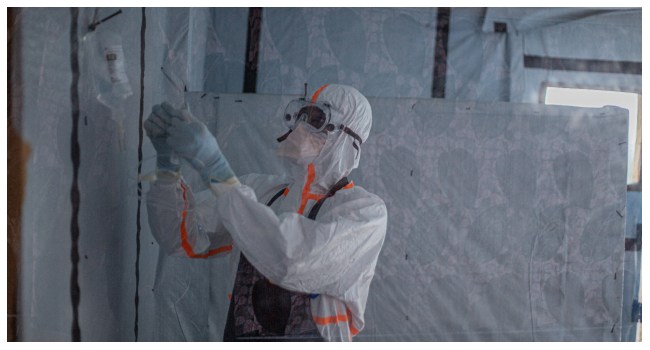
The Federal Government has confirmed a case of Ebola virus disease in the Federal Capital Territory (FCT). Coordinating Minister of Health and Social Welfare, Muhammad Pate, announced that laboratory testing had verified the imported case.
At a media briefing in Abuja on Tuesday, Pate explained that the patient is a woman who recently traveled to East Africa specifically Uganda—and returned to Nigeria on October 7th.
She began experiencing symptoms soon after her arrival, which worsened over the following four days before tests confirmed the infection. The patient is now in isolation, receiving medical care, while health authorities have already identified forty-four contacts and begun contact tracing. Surveillance at Nigeria’s entry points has also been intensified.
According to a government statement, the patient was admitted to a private hospital, where she received treatment for several days prior to the diagnosis. She remains in isolation as medical teams continue her care.
Minister Pate emphasized that the Ministry of Health is working closely with the FCT Health Secretariat, Africa Centres for Disease Control and Prevention (Africa CDC), and other partners to contain the infection and prevent further spread.
He urged all health facilities to remain vigilant and called on health workers to be alert for possible cases.
The public was advised to maintain good hygiene, look out for symptoms like fever, weakness, headache, and diarrhea, and cooperate with health officials. Pate assured Nigerians that the situation is under control, promising timely and transparent updates as containment efforts continue.
He noted that Nigeria is drawing on its experience from the 2014 Ebola outbreak and existing public health systems to track and monitor all identified contacts.
The announcement follows an outbreak in the Democratic Republic of Congo (DRC) in May, which has since spread to several countries, including neighboring Uganda. Kenya’s health ministry also reported its ninth Ebola case on Tuesday.
Jean Kaseya, Director General of Africa CDC, described the current Bundibugyo Ebola outbreak as the most geographically widespread in history, affecting multiple countries across three African regions.
In the DRC alone, the epidemic has become the deadliest in the country’s history, with over 4,381 deaths among more than 9,000 confirmed cases, according to local health authorities.
Following the outbreak, the Nigeria Centre for Disease Control and Prevention (NCDC) heightened surveillance and reviewed preparedness measures.
While the case was linked to the ongoing outbreak in the Democratic Republic of Congo, its detection in Kenya underscores the risk of international importation through travel and population movement, including the possibility of importation into Nigeria,” the NCDC stated.
Nigeria’s first recorded Ebola case was in 2014.