



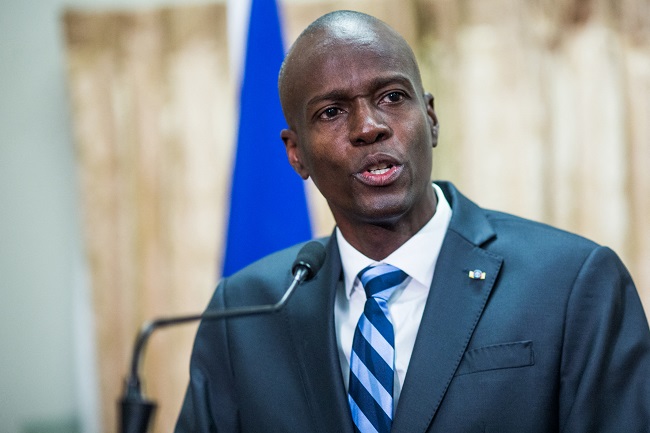
Eighteen suspects have been arrested in connection with the 2021 assassination of Haitian President Jovenel Moïse, as U.S. authorities intensify what has become a five-year investigation into one of the Caribbean’s most significant political killings.
The suspects, previously detained in Haiti, were flown by U.S. military aircraft to South Florida, where they now face federal charges related to the plot that ended Moïse’s presidency and deepened Haiti’s political and security crisis.
Moïse, 53, was killed in his private residence outside Port-au-Prince in the early hours of July 7, 2021, when armed men stormed the property. His wife, Martine Moïse, was wounded in the attack. Investigators say the operation involved military-trained Colombian mercenaries, recruited as part of a broader conspiracy to oust the Haitian leader.
U.S. Attorney for the Southern District of Florida Jason Reding Quiñones confirmed the operation, stating that 30 people have been indicted so far for their alleged involvement in the assassination. “Five years later, we are still bringing defendants before American courts, and we are not finished,” Quiñones said, adding that prosecutors remain committed to pursuing anyone who financed, facilitated, supported, or directly participated in the killing.
FBI Special Agent in Charge Brett Skiles described the arrests as evidence of Washington’s determination to identify all those involved. According to Skiles, the FBI believes some conspirators sought to profit from business opportunities expected to arise after Moïse’s removal from power.
The 18 defendants now in U.S. custody include Colombian nationals and several key suspects. Among them is Joseph Felix Badio, a former Haitian anti-corruption official identified by investigators as a major suspect. The Colombian government, which is monitoring the transfer of 17 of its citizens, emphasized that it was not involved in the decision to move them. Colombia’s Foreign Ministry said the process was handled by Haitian and U.S. authorities.
American courts have become central to prosecuting those accused, as parts of the alleged conspiracy were planned and financed from South Florida. U.S. prosecutors say funds, weapons, personnel, and logistical support connected to the operation passed through the United States before the assassination took place.
The investigation has already led to major convictions. In May 2026, a federal jury in Miami found four men—Arcangel Pretel Ortiz, Antonio Intriago, Walter Veintemilla, and James Solages—guilty of conspiracy to kill or kidnap a person outside the United States, and providing material support that resulted in death. All face possible life sentences.
Prosecutors said Intriago was linked to CTU Security, a South Florida private security company central to the recruitment of Colombian mercenaries. Evidence at trial showed Intriago traveled to Haiti shortly before the assassination and communicated with other alleged conspirators as the plot took shape. Solages acted as a liaison in Haiti, coordinating between South Florida and the Caribbean nation and helping to organize activities involving armed groups.
Authorities say what began as a plan to remove Moïse from power ultimately became an assassination plot. Another figure, South Florida fundraiser Keegan Harricharan, was sentenced in July to 20 years in federal prison after pleading guilty to money laundering. Prosecutors said illegally obtained COVID-19 relief funds were laundered to help finance the plot against Moïse.
While the U.S. investigation has yielded indictments, convictions, and lengthy sentences, progress has been much slower in Haiti. Five years after the killing, Haiti has struggled to bring suspects to trial amid ongoing instability, insecurity, and heavy pressure on its justice system. The transfer of the latest suspects to the United States has reignited debate over Haiti’s ability to prosecute one of its most significant criminal cases.
Moïse’s assassination created a power vacuum, further destabilizing a country already beset by poverty, weak institutions, and the growing influence of armed groups. Haiti still lacks an elected president, and heavily armed gangs now control large parts of Port-au-Prince. Killings, kidnappings, and displacement are widespread as security forces struggle to restore order. Authorities are now preparing for presidential and legislative elections in hopes of reestablishing constitutional government.