



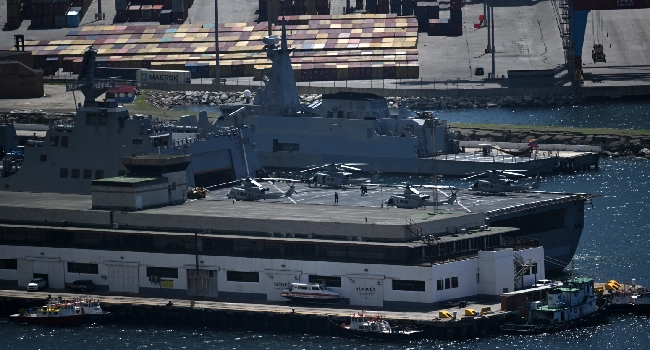
The US military rushed to reopen a major port in Venezuela on Monday to accelerate the delivery of humanitarian aid, as the death toll from last week’s twin earthquakes climbed above 1,700 and tens of thousands remained missing.
Five days after powerful quakes devastated the coastal state of La Guaira, hopes of finding survivors are rapidly fading.
Entire neighborhoods of multi-story buildings have been reduced to rubble. At a makeshift morgue in a port warehouse in La Guaira, hundreds of bodies lay in white and black body bags and coffins, awaiting identification, according to an AFP correspondent. Outside, anxious families gathered for news as forensic teams examined the dead.
“There were 11 people in my household; only two of us survived because we were at work,” Wilker Molalla told AFP. “My family is there—I’m told my sister and her children are there, as well as my brother’s children.”
Meanwhile, US Marines worked to repair the quake-damaged port, aiming to restore the flow of essential supplies and equipment, according to a US administration official. American airmen were also helping to reopen Simon Bolivar International Airport near Caracas, which suffered heavy damage in one of Latin America’s worst earthquake disasters. The airport has now partially reopened to cargo and aid flights.
US helicopters have been ferrying in relief, while Marines have used landing craft to deliver supplies from the USS Fort Lauderdale, an amphibious transport dock now stationed in La Guaira. Despite these efforts, the chances of finding anyone alive beneath the debris have diminished since the crucial 72-hour window passed.
Still, hope briefly surged when a WhatsApp message reportedly came from a woman trapped under a collapsed apartment building in Caraballeda, one of the hardest-hit areas. More than 120 hours after the disaster, a volunteer rescuer told AFP that she messaged her building’s caretaker to say she was still alive. In another rare rescue, a 21-year-old man named Aaron Levi was pulled from the rubble in nearby Tanaguarena, according to video footage of the operation.
Frustration is growing among Venezuelans over what many see as the sluggish response from their US-backed government. Wednesday’s twin quakes, measuring 7.2 and 7.5 in magnitude, injured more than 3,100 people and were felt as far as neighboring Colombia—marking Venezuela’s worst earthquakes in over a century. A strong aftershock, measuring 4.6, struck Monday morning, raising fears for the stability of hundreds of already weakened buildings.
Twenty-four countries have sent 521 tons of aid, including teams with search dogs and more than 2,700 rescue personnel, according to interim president Delcy Rodriguez. On Monday, the US doubled its aid pledge from $150 million to $300 million. Yet, the scale of destruction has left a nation already battered by economic crisis struggling to respond. National Assembly President Jorge Rodriguez reported that 774 buildings were severely damaged, including 189 that have completely collapsed.
Luis Salas, 27, who joined the rescue efforts, described the heartbreak of searching: “The hardest part was when we felt hope in the tunnels—crawling, clearing debris, working with all our heart—and when we reached our targets, we found them lifeless.”
Tensions have flared in some areas as residents grew impatient with the official response. In Tucacas, volunteer Eduardo Cardozo called it “frustrating” to know some victims might have been saved with a faster search. On Sunday, residents demanded that soldiers put down their weapons and join the rescue effort. Outbreaks of looting have also been reported in La Guaira, with pharmacies, supermarkets, and other businesses ransacked amid complaints of slow and insufficient aid.
Authorities are now setting up temporary camps for those who lost their homes. The UN migration agency estimates that up to 6.76 million people could be affected and in need of shelter, water, sanitation, healthcare, and other essential relief.